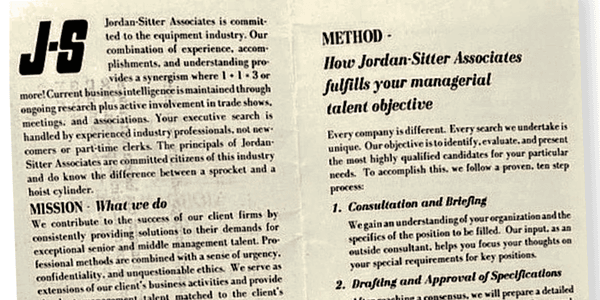
In 1978, a Jordan-Sitter Associates brochure made a simple promise to clients: “You will not receive a pile of resumes.”
At the time, gathering a pile of resumes took real effort. Today, it takes almost none. That is exactly why the promise matters more now than it did then, and why careful candidate evaluation has become the most valuable part of a search.
The Problem With Volume
Modern recruiting technology has made it remarkably easy to find people. A job posting can draw a flood of applications. A database search can return hundreds of possible matches. It can feel like progress. In practice, a long list often creates more work than it saves.
Someone Still Has to Sort the Pile
Every resume takes time to read and consider. When a recruiter passes along dozens of them, the sorting has not been done. It has simply been handed to the client.
In the equipment industry, the person doing that sorting is often a dealer principal, a general manager or a department head who already has a business to run. Time spent reviewing marginal candidates is time taken away from customers and employees.
Easy to Find Is Not the Same as Right for the Role
Volume can also hide the best candidates. The people who respond quickly to a posting, or whose profiles happen to match the right keywords, are not always the people best suited to the position.
Many of the strongest candidates are not actively looking. They will never appear in a stack of applications.
What a Resume Can and Cannot Tell You
A resume is a useful starting point. It shows where someone has worked, what positions they have held and how long they stayed. It cannot fully explain how they lead, what motivates them, how they have built relationships or whether their approach will fit the needs of a particular organization.
The Questions Behind the Resume
The information that matters most usually comes from conversation. These are some of the questions a resume leaves open:
- What did this person actually accomplish, and what was their own part in it?
- Why did they make each career move?
- How do they lead when circumstances are difficult?
- What are they looking for next, and does this role truly offer it?
- Will the way they work fit the culture of this company?
Two candidates with nearly identical resumes can give very different answers.
What Careful Candidate Evaluation Looks Like
Our clients do not need us to give them more profiles to sort through. They need us to narrow the field, ask the right questions and provide honest insight into the people being considered.
It Starts With the Client
Good candidate evaluation begins before we speak with a single candidate. We need to understand the company, the department and what success in the position should look like. Without that understanding, there is nothing meaningful to evaluate a candidate against.
It Depends on Real Conversations
From there, the work happens in conversation. We talk with candidates about their experience, their goals and the reasons behind their decisions. Because we know the equipment industry, we can ask questions that go beyond the surface and recognize which answers carry weight.
It Requires Honesty
Sometimes careful evaluation means telling a client that an impressive candidate is not the right fit. Sometimes it means recommending someone whose background looks less conventional on paper. In either case, our responsibility is to share what we have learned, including any concerns.
Fewer Candidates, Better Decisions
When a client receives a small group of well-considered candidates, the hiring decision becomes clearer. Interviews are more productive because each person in the process has a real chance of being the right hire.
Candidates benefit as well. They are presented only for opportunities that make sense for their experience and their goals, and their time is respected. That was the thinking behind our work in 1978, long before digital recruiting platforms existed. No pile of resumes. Just the right people, carefully considered.