Equipment Industry Hiring: How the Right Hire Strengthens an Organization
“The success and strength of your organization hinges on the competency level of your team.” The wording may come from another era, but the idea…


From changing oil to analyzing telematics: One professional’s evolution shows how maintenance roles are transforming.
I recently interviewed a proven Fleet Manager who started his career the traditional way: wrenching, changing oil, and changing tires on mobile machinery. More than twenty years later, he’s still in maintenance, but his toolkit has expanded way beyond hand tools. Managing 1,700 assets across heavy equipment and on-road fleets, this type of candidate represents a new breed of maintenance professional: one who combines hands-on expertise with data analytics to drive real results in uptime and cost reduction.
His journey offers practical insights for maintenance professionals navigating an industry where preventing failures increasingly depends on interpreting data as much as understanding mechanics.
The candidate’s foundation remains rooted in technical expertise. His early years included a stint with Cummins rebuilding heavy equipment engines from 35L to 90L displacement, which is work that required precision measurement and root cause analysis of engine failures.
The candidate said in our interview about understanding engines, “it has helped me in my career as a Director of Fleet.” This deep technical knowledge later proved invaluable when analyzing fleet-wide failure patterns and negotiating warranty claims with OEMs (critical to bringing down total cost of ownership).
Data analytics tools, just like any other tool, are only as good as the person using them. Understanding why components fail. Not just when they fail. This provides the context needed to make effective maintenance decisions and spot patterns that automated systems might miss.
Nothing illustrates the evolution of fleet maintenance more than a solid approach to telematics. The candidate describes himself as “a freak about telematics,” using VisionLink to consolidate data from multiple OEM systems across his entire 1,700-asset fleet.
“From idle time to looking at fault codes to oil sample trends, we do everything on there”, the candidate told me. This comprehensive data approach allows his team to predict failures, optimize maintenance schedules, and track performance trends across different equipment types and work environments.
The practical impact is significant. Instead of relying solely on scheduled maintenance intervals, his team can identify machines requiring attention based on actual operating conditions and fault codes. This targeted approach reduces both unexpected downtime and unnecessary maintenance work.
For maintenance professionals, telematics fluency is becoming as essential as mechanical knowledge. Those who can effectively interpret and act on telematics data will drive better outcomes than those relying on traditional methods alone.
For this candidate, experience managing both heavy equipment and on-road fleets highlights crucial differences that affect maintenance strategies. “On-road fleet, you’re running a little bit narrower margin for spare ratios because every truck sitting there doesn’t make money,” he notes. “It’s a different type of environment because it’s a daily grind.”
This distinction affects everything from parts inventory to repair prioritization. On-road fleets typically require faster turnaround times and higher spare ratios, while heavy equipment operations may have more flexibility to schedule maintenance around project timelines.
The key insight for maintenance professionals is understanding how business operations drive maintenance requirements. A garbage truck down for a day impacts route schedules immediately, while a bulldozer might be scheduled for maintenance during equipment rotation without affecting project timelines.
One of the most valuable observations brought up in our interview concerns organizational scaling. Many companies grow their fleets without developing the maintenance infrastructure to support them effectively.
This challenge directly impacts maintenance professionals. The processes that work for a 50-unit fleet often break down at 200+ units. Success requires proactive investment in systems, training, and standardized procedures before operations outgrow current capabilities.
Maintenance professionals can drive this conversation by documenting current processes, identifying bottlenecks, and proposing scalable solutions. Those who think systematically about maintenance operations and not just individual repairs position themselves as valuable strategic assets.
Fleet maintenance leaders can directly impact financial performance, sometimes for better and sometimes for worse. The candidate mentioned that his team tracks metrics like cost per ton, total cost versus revenue, and equipment utilization rates. In one role, he helped reduce operational costs from 7% to 6% of revenue. a significant improvement that required combining maintenance expertise with business and financial acumen. For a large fleet one percent makes a huge impact to the bottom line.
Financial focus doesn’t diminish the importance of technical skills, rather it amplifies them. Maintenance professionals who can connect their technical decisions to business outcomes become indispensable to their organizations.
My interview yields several actionable strategies for maintenance professionals:
This candidate’s career illustrates how maintenance roles are expanding beyond traditional boundaries. Modern maintenance professionals need technical expertise, data analysis skills, vendor management capabilities, and business understanding.
“I tell people now when they’re getting hired, your first year you’re learning. Your second year, you’re implementing what you learned. Year three, you better be on 100% because if you’re not, then we need to talk about where’s your replacement.”
This timeline reflects the complexity of modern maintenance operations. New hires need time to master not just mechanical skills, but also the technological tools and business processes that drive effective maintenance programs.
Companies succeeding in today’s competitive environment are those that view maintenance as a strategic function, not just a cost center. They invest in both technology and training, understanding that effective maintenance requires sophisticated tools and skilled professionals to use them.
For maintenance professionals, this evolution creates opportunities for those willing to expand their skill sets. The future belongs to those who can bridge technical expertise with data analysis, combining years of hands-on experience with modern diagnostic and predictive tools.
The difference is that today’s fleet maintenance professionals have far more powerful tools to apply these principles—and far greater potential impact on their organizations’ success.
Modern Fleet Managers will thrive with both wrench skills and data analytics capabilities. Those who master both will drive the downtime reductions and cost savings that separate industry leaders from the competition.
Whether you’re building your team or advancing your career, we can help you connect with the right opportunity.
“The success and strength of your organization hinges on the competency level of your team.” The wording may come from another era, but the idea…

In 1978, a Jordan-Sitter Associates brochure made a simple promise to clients: “You will not receive a pile of resumes.” At the time, gathering a…
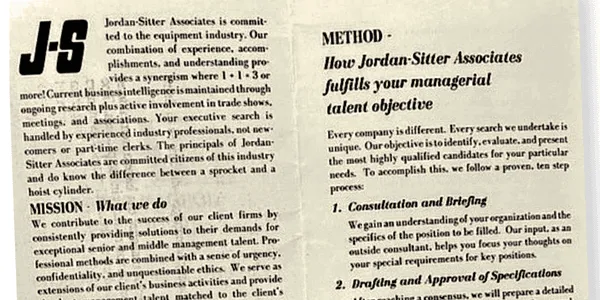
Someone sent us an original Jordan-Sitter Associates brochure printed in 1978. He had kept it for more than 45 years, and seeing it again felt…