Equipment Industry Hiring: How the Right Hire Strengthens an Organization
“The success and strength of your organization hinges on the competency level of your team.” The wording may come from another era, but the idea…


Hiring diesel technicians and heavy equipment mechanics has never been more difficult, or more critical. Demand keeps climbing, the talent pool keeps shrinking, and every unfilled position puts pressure on your shop, your field service team, and ultimately your customers. You’re not just trying to fill a seat; you’re trying to keep machines running, timelines on track, and revenue flowing. Yet even with the best intentions, most companies end up relying on hiring methods that simply can’t keep pace with today’s workforce challenges. And that’s where the real trouble begins.
You need to hire diesel technicians and heavy equipment mechanics to support your shop or field service operations. Your typical strategy usually involves employee referrals, which are great when your business is small. But when your referral tap runs dry this causes you to rely on job postings, also known as job advertisements. Job postings are great if you happen to have a qualified candidate looking for a job at the exact time you are posting your advertisement. But if we are being honest with ourselves, how often do the planets align and get you a qualified job applicant quickly?
Assuming your referrals and job postings are failing, then perhaps you break down and decide to get an agency recruiter involved? More than likely, you do this with some hesitation. If you are like most heavy equipment companies, you think the cost and risk is too high. Ringing any bells?
The truth of the matter is that heavy equipment mechanics are the lifeblood of your operation. Without them, you’ll struggle to keep machines running, and that is costing your customer a lot of money and putting your customer satisfaction at risk. If you can’t get this problem solved, then it will start costing you a lot of money, too! In fact, it probably already is costing you revenue and damaging your reputation.
Unfortunately, employee referrals usually tap out pretty quickly, so you fall back on your “post and pray” strategy. You take your average, at best, job description, cut and paste it onto a job board and then you wait. It’s a bit like fishing. Your job posting is the bait, and you are fishing for mechanics. Sadly, even if you catch something it likely will either be too small to keep because they’re inexperienced or is the wrong type of fish entirely.
We’ve learned that the quality of job applicants from postings is typically no better than ten percent. Not a great number! If you have a low number of applicants then you may not waste a lot of time, but it gives you very little to consider for hire. If you have a high number of applicants, then you’re wasting an incredible amount of time looking at resumes that aren’t even close to what you need. It’s a no-win situation for heavy equipment companies. Maybe you get frustrated enough that you opt to engage a staffing or recruiting agency. You find, though, that they often just lob poorly vetted resumes and candidates into your inbox without understanding the specific skills needed for heavy equipment work.
Even if you get a resume of a candidate worth hiring, there’s a good chance the long-term return on investment won’t justify the fee. Not to mention, you’ve waited until your pain is so high that you will probably hire a heavy equipment mechanic that you know in your heart isn’t the right fit. But because they can fog a mirror, you are more than happy to extend them a job offer. Maybe you get lucky and the candidate is a good fit, but more than likely they’ll barely get by or worse, and then go find another job somewhere else leaving you in no better position than before making the hire. Painful, right?
Here’s the thing. Heavy equipment technicians are billable resources. Assuming you have a decent recovery rate, every hour they work makes you money. But hiring a bad technician, even with a good recovery rate, doesn’t ensure individual profitability. If the tech is slow, or does shoddy work, then the rework will eat into your profit, not to mention frustrate your customer. Once your customer has reached boiling point, they’ll likely start taking their business elsewhere. This is why they say that “sales sells the first, but service sells the rest.” However, poor product support could likely lead your customer to another brand, and then you’re in trouble. There’s a solution, though.
Never stop recruiting! Building a pipeline of qualified diesel technicians and heavy equipment mechanics is essential. Don’t wait until positions are vacant to start looking.
Never sacrifice on quality including skills and culture fit. An unfilled job is better than hiring a bad fit! A poor hire damages your service department, frustrates customers, and hurts your bottom line more than a temporary vacancy.
Train and develop your technicians. Let me say that again in another way: invest in your people! Providing ongoing training, certification programs, and career development keeps your best diesel technicians engaged and improves their skills.
Provide great leadership and take care of your technicians. Be honest and be fair! Heavy equipment mechanics want to work for companies that value them, offer competitive pay, provide good benefits, and maintain a positive work environment.
Partner with a recruiting agency that knows what they are doing to augment your recruiting efforts! Working with specialized heavy equipment recruiters who understand the technical skills required and have networks of qualified diesel technicians makes a significant difference.
Ignoring these things will negatively impact customer satisfaction, employee satisfaction, quality and safety, and financial performance at your heavy equipment operation.
We’ve been recruiting in heavy equipment for over 40 years. While our focus has largely been on hiring management talent, one thing that has not changed is the demand for technicians. The diesel technician shortage affects the entire heavy equipment industry. That’s why Jordan Sitter is now recruiting technicians for select clients!
If you’re struggling to find qualified diesel technicians and heavy equipment mechanics, contact us today at 210-798-5888. Our specialized recruiting approach helps you find technicians who have the right skills, fit your culture, and will stay long-term.
Whether you’re building your team or advancing your career, we can help you connect with the right opportunity.
“The success and strength of your organization hinges on the competency level of your team.” The wording may come from another era, but the idea…

In 1978, a Jordan-Sitter Associates brochure made a simple promise to clients: “You will not receive a pile of resumes.” At the time, gathering a…
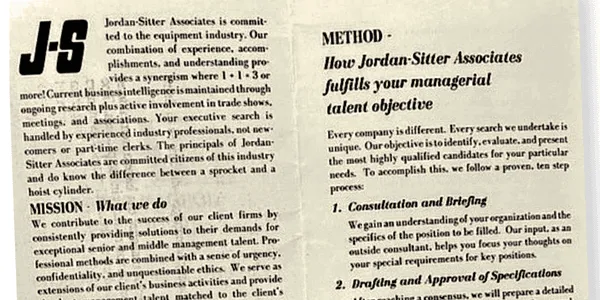
Someone sent us an original Jordan-Sitter Associates brochure printed in 1978. He had kept it for more than 45 years, and seeing it again felt…